Fred, passionate Nohô host, illustrator, and linocut artist

from Nohô
On Friday 13 February 2026 at 15:22
Introduction
At 31, Fred decided to return to her first love: artistic creation. A former bookseller forced to stop working for health reasons, she rebuilt her life through digital drawing, gouache, watercolor… before discovering linocut, which became a true passion.
For more than three years, she has been exploring this artisanal printing technique, combining meticulousness, experimentation, and meditation. On Nohô, she shares her expertise to make linocut accessible to everyone.
Can you introduce yourself?
My name is Fred, I’m 34 years old, and I’m an illustrator and linocut artist.
I used to be a bookseller, but I had to stop because of back problems. So I returned to my first love: artistic creation.
I had studied art when I was younger, but as I couldn’t get into art school, I moved on to something else. Then I picked it all up again at the age of 30.
I started by learning digital drawing by streaming on Twitch, with this idea: “Come and watch me struggle to learn digital drawing because I’ve never done it before. “
Then I explored gouache and watercolor, which I loved. Then I discovered linocut… and it became my great passion. I’ve been practicing seriously for a little over three years now.
Are there different techniques in linocut printing? Can you tell us about them?
Yes, of course.
Linocut printing is a positive printing technique: anything that is carved out does not print.
You can engrave on linoleum—which is the most affordable and easiest material to work with because it is softer—but also on wood or other materials. I mainly work on gray linoleum. There are also materials such as rubber, which is more similar to the principle of a stamp.
My formats range from A6 to A3, and I would like to be able to work on even larger formats one day.
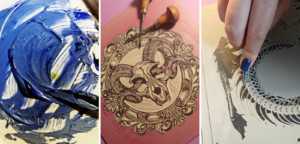
In practical terms, you carve the plate, then ink it with a roller. Next, you press the paper onto it quite firmly to transfer the ink. It’s quite physical, actually.
You can print a work infinitely or choose to work in limited editions. Personally, some engravings are limited to 30 or 50 copies. Others are printed according to demand.
Can you work with multiple colors in linocut?
Yes, it’s possible. There are two main methods.
The first is called reduction linocut. You engrave once, print, then re-engrave the same plate, removing material, print with another color, and so on. As you go along, the previous colors appear underneath. This allows you to create multi-layered works.
The second method, which I am beginning to experiment with, involves creating gradients.
For example, I can use blue and pink: a blue roller, a pink roller, then a roller that mixes the two to create the transition. This allows you to print multiple colors in a single pass.
Is there a piece you’re particularly proud of?
Yes, one of the last ones I made. It showed me how much I’d improved in terms of the finesse of my engraving.
I called it “Le Chatbouc.”
I started a series based on a cabinet of curiosities. Two years ago, I created the first piece: a raven’s skull with deer antlers, in a baroque frame called “Le Cornebeau.” I wanted to print the frame in gold, but I had trouble finding the right ink, so I put it aside.
In October, I finally completed the second piece: a cat skull with goat horns in a magnificent baroque frame. This work took me a long time, but I’m very proud of the final result.
Are you the co-creator of Drink & Draw?
Yes. My husband and I moved to Normandy about a year ago. Before that, we lived in Bordeaux, where there was an activity called Drink & Draw, which was a gathering of artists and creative people over drinks for an evening. It was a concept we were already familiar with, but we had never had the opportunity to go.
When we arrived in Caen, we realized that it was missing and decided to create it ourselves. The first edition was in December 2025. Every month, we organize a gathering with artists under the auspices of Drink & Draw. We’ll see how it evolves; it may become more regular because we have other places that would be interested in hosting us. But this is just the beginning of the adventure, so we’ll see how it goes!
What do you offer on the Nohô platform?
The idea is to introduce people to linocut and engraving in general, because it’s a very accessible technique.
You can really engrave with lots of materials if you’re a little inventive. I like to say that it’s a bit of a “pirate” technique: you can experiment easily.
For me, engraving is almost a form of meditation. When I’m engraving, my mind goes blank, and it does me a world of good.
I’ve met lots of people who have tried linocut and loved it, but who felt lost because of the lack of clear information. You often have to search high and low.
So on Nohô, I offer:
- an introduction to the basics of engraving
- an explanation of the different materials and tools
- a sharing of the beginner’s mistakes we all make
- help to get started right away to avoid frustration and wasted time
If this helps someone get started with linocut engraving with confidence, then the goal is achieved.
Conclusion
Fred’s journey is one of rediscovery. After a forced break, she turned a constraint into an opportunity to reconnect with artistic creation.
Through linocut printing, she explores an art form that is technical, physical, and deeply soothing. Her work combines finesse, imagination, and a unique universe, particularly around the cabinet of curiosities.
On Nohô, she offers more than just an introduction to art: she shares an accessible, meditative, and liberating practice, giving everyone the desire (and the keys) to create.
What if, like Fred (see his Instagram), you shared your passion on Nohô? : Sign up now and create your ad for free on Nohô.
from Nohô
On Friday 13 February 2026 at 15:22
You may also be interested in these articles