Christophe Breton, Nohô host, author and photographer: between art and transmission

from Nohô
On Monday 16 March 2026 at 15:51
Christophe Breton, Nohô host, author and photographer: between art and transmission
Introduction
An author and photographer for three years and a photographer for over twenty years, Christophe Breton explores the traces left by humans in urban spaces, while developing an artistic practice that combines photography, painting, and sculpture.
Through his unusual career path, he shares a sensitive vision of art, nourished by encounters, galleries, and a strong desire to pass on his knowledge. On Nohô, Christophe offers above all a space for exchange, to make the world of art more accessible and more human.
Can you introduce yourself?
My name is Christophe Breton. I have been an author and photographer for three years, but a photographer for over twenty years.
Previously, I was a freelance photographer. I started out in sports, particularly motor sports, and then, one thing led to another, and I found myself doing studio photography: family photos, weddings, portraits, baptisms, communions.
Three years ago, I took the plunge and became a professional photographer. I had already started working in fine art photography, as well as painting and sculpture, and I was already collaborating with artists. Today, it has become my main activity.
What is your background?
I started photography as a self-taught photographer. Then I took a one-year correspondence course with Educatel.
It was mainly through practice, encounters, and fieldwork that I was able to develop my vision and my universe.
How would you define your universe as a professional photographer?
My universe is special, I work a lot with absence and urban environments.
Everything related to buildings, empty places, spaces stripped of human presence, but where there is always a trace left behind: graffiti, posters, a café terrace with a forgotten cup on a table… something that suggests that people have been there before.
That’s really the heart of my photographic work.
Alongside that, I’m also developing my work in painting and sculpture, which is a little less present at the moment, but which I continue to explore.
Are you a photographer for artists?
I currently work for four or five professional artists. They contacted me.
Supporting sculptors and visual artists
For some sculptors, I take photos for art galleries.
For example, I work with a sculptor in Sourdeval: I take care of his photos, send them to galleries, and create his online portfolio. He doesn’t have to manage anything on his end: our contract includes digital files and a photo print, but he hardly ever handles the files.
Photography and reproduction of works
I also work with a marquetry artist.
In this case, I photograph her works, prepare the files for printing, and she then uses them to create posters that she frames and displays at art fairs or in shops.
Photography can have several roles:
– promotion
– reproduction
– communication
– artistic dissemination
There is no single use; it all depends on the artist’s needs.
Are painting and sculpture another facet of your work?
Yes, working with sculptors and painters has led me to frequent many art fairs and galleries.
That’s how, seven or eight years ago, I started painting and sculpting.
One of my clients, who has now become a close friend (he is 82), really encouraged me to take up these practices.
If I talk about sculpture, I am mainly referring to assemblage, with a dimension of denunciation, particularly in relation to what is happening in France. Some would call it staging or installation.
When it comes to painting, I work mainly in the abstract, using color as my primary language.
What do you offer on Nohô?
On Nohô, I want to share my knowledge in the fields I work in, but also what I’ve learned about art galleries, exhibitions, and artists in the region. For example, many people don’t know that there are high-end exhibitions open to the public, such as the one at the Couvent des Jacobins in Rennes.
There are also many people who don’t dare to enter a gallery, thinking that they have to pay or that it’s not for them.
Another example: the Musée des Beaux-Arts in Rennes is now free, yet many people still think that it isn’t.
So on Nohô, it’s mainly a discussion to:
- understand how to access the world of art
- dispel preconceived ideas
- encourage people to be bold
And of course, I can also advise on buying a camera, on courses, or on ways to get started in photography.
Do you have a photo you’re particularly proud of?
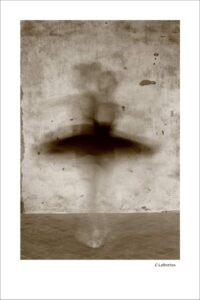
Yes. I used to do ballet and I have a real passion for dance in general, even though I don’t practice it anymore.
Lately, I’ve started reintroducing dancers into urban environments, places where people don’t normally dance: supermarket parking lots, the Avranches train station, very raw spaces.
I worked with a tango couple, among others. The photo I’m going to send you was taken for an exhibition in a castle. It was a long exposure of three and a half seconds, during which the dancer did two pirouettes. We had finished the main shoot, we were ahead of schedule, and we said to ourselves, “Hey, let’s try something a little crazy.”
That’s often how the most powerful images are created.
Conclusion
Through his perspective on absence, space, and movement, Christophe Breton explores sensitive photography. At the crossroads of art and humanity.
His career, nourished by practice, encounters, and curiosity, has led him to become a true facilitator. Between artists, galleries, and the general public.
Nohô is not just about technique or aesthetics, but above all about demystifying the art world. It encourages curiosity and opens doors to those who have not yet dared to step through them.
What if, like Christophe (see his Instagram), you shared your passion on Nohô? : Sign up now and create your ad for free on Nohô.
from Nohô
On Monday 16 March 2026 at 15:51
You may also be interested in these articles