Tristan, Nohô Host in Sète: A Cultural Bridge Between France and Traditional Chinese Kung Fu

from Nohô
On Tuesday 25 August 2026 at 10:47
Tristan, Nohô Host in Sète: A Cultural Bridge Between France and Traditional Chinese Kung Fu
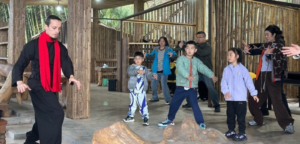
Some passions aren’t limited to a single discipline. They open the door to an entire culture, a philosophy, and a way of being in the world. For Tristan, Kung Fu is all of these things at once. An instructor in three traditional styles, he has been traveling back and forth between Sète and China since 2024, bringing with him something rare: direct access to the authentic sources of martial arts that few Westerners have had the opportunity to experience. On Nohô, he doesn’t offer to fight. He offers insight.
Can you introduce yourself?
My name is Tristan Mouliot, and I serve as a cultural bridge between France and China. When I’m in France, I promote Chinese culture. When I’m in China, I promote French culture. I am a martial arts instructor, a third-generation member of the Dai (代) clan from Sichuan (四川) province, and a tenth-generation practitioner of BaJi Quan (八极拳) from the Wu (吴) family.
What has your journey been like?
My journey in martial arts began at a very young age, with several disciplines: savate, sambo, judo, and seven years of floor and apparatus gymnastics. Six years ago, I started practicing Kung Fu seriously, taking private lessons in the Shaolin style. But that wasn’t really what I was looking for. Very quickly, I joined the Wu family’s club in Sète, the BaJi Quan club. And since 2024, I’ve been traveling back and forth to China to deepen my training six months in France, six months in China.
You practice and teach three different styles. Can you tell us about them?
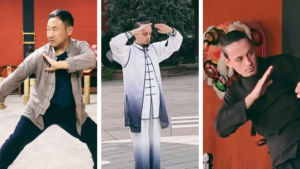
The first is BaJi Quan (八极拳), the Wu (吴) family style. It’s a style that has been passed down from father to son for many generations. Historically, it’s known for having been used by the bodyguards of China’s last emperor during the Qing Dynasty. It’s a very explosive style, which I liked immediately.
The second is TaiJi Quan (太极拳), or Tai Chi as it’s called in France, in the Chen style. This is the one that appeals to the widest audience, because not everyone necessarily wants to fight. TaiJi focuses on the body’s internal and external mechanics. In my view, it’s a fundamental discipline almost mandatory regardless of which path you choose in Kung Fu.
The third is my main school: DaiShiMen (代氏门), a style inherited from Mount Emei (峨眉山), the sacred mountain of Sichuan (四川), the cradle of Taoism, where Buddhism and Taoism intertwine. I am the third generation in this style. Grandmaster Dai (代师爷) left the sacred mountain to spread these teachings, and it is Master Li Quan (李全师父) who now teaches in Chengdu (成都). That is where I train. It is a very martial style, which I tend to reserve for people who truly want to develop combat skills.
Do you have any athletic goals?
My athletic goals are tied to my passion in general: to introduce these styles to as many people as possible. I competed in the French National Kung Fu Open in full-contact, where I finished second. I regularly participate in the Rebels Martial Arts Festival in Germany. And my ultimate goal is to win the Mount Emei provincial tournament in China, which would be equivalent to winning a national tournament in Europe, since Sichuan Province is comparable in size to France.
What do you offer on Nohô?
What I want to offer on Nohô is, above all, a cultural approach. I know that the people who come want to learn, not to fight. So I emphasize the culture, history, and principles of these styles. My goal is also to demystify Kung Fu. In recent years, it has suffered from a false positive image particularly due to Hong Kong cinema and then a genuinely negative image caused by charlatans who invent theories about energies and traditional medicine with no real basis. I want to show the authentic side, just as I learned it firsthand in China, within lineages that trace back to the founders. And I hope that through this event, people will want to come to the club in Sète or even travel to China.
When Kung Fu Opens a Window onto China
On Nohô, certain encounters take you on a journey without leaving your seat. Tristan’s is one of them. Not a stunt show, not a self-defense lesson: an hour to understand what traditional Kung Fu really is, where it comes from, and what it conveys. With someone who has traveled all the way to its origins to bring it back to you. A rare experience, in Sète.
Why not share your passion on Nohô, just like Tristan? Create your listing for free in less than 5 minutes.
from Nohô
On Tuesday 25 August 2026 at 10:47
You may also be interested in these articles