Michel Smekens, Nohô Host in Ardèche: A Lifetime Devoted to Art and the Visual Experience

from Nohô
On Monday 31 August 2026 at 15:27
Michel Smekens, Nohô Host in Ardèche: A Lifetime Devoted to Art and the Visual Experience
Some callings are born in a flash. For Michel, it happened in a Baroque chapel in Germany at the age of five, when the sun struck the golden heart of the altar. That day, he told his father he would do art. His father, a soldier, replied that it was magnificent, but that they were a whole team and he was all alone. Michel replied, “I’ll draw.” He hasn’t stopped since that day. Today, in his studio-gallery in Le Cheylard, Ardèche, he shares on Nohô what has driven him for over 50 years: art as a window to the world, and drawing as a universal right.
Can you introduce yourself?
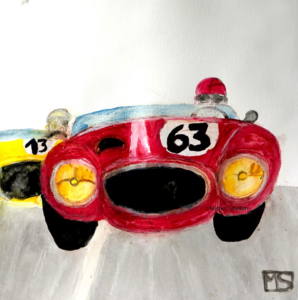
I’m a professional artist. My passion for art was born at the age of five in a Baroque chapel in Germany. I was captivated by the golden heart of that chapel, and that’s when I decided that this was what I wanted to do. My parents encouraged m. I had a certain flair for drawing. In Belgium, the Franco-Belgian “clear line” school inspired me greatly. At 18, I wanted to enroll in art school, but my mother steered me toward more traditional studies. I continued to draw on my own until I was 35, before enrolling at the Academy of Fine Arts in Leuven, where I studied for 10 years. Paradoxically, I only took drawing classes there—never a single painting class. That’s why, for a very long time, all my art was in black.
Can you tell us about the different periods in your career?
I’ve gone through several artistic periods. After a long period of darkness, I met Martine, my wife, in 2008—she’s an artist herself, trained at the Beaux-Arts in Bordeaux and Orléans. She had discovered one of my works online and wrote to me saying she felt a musical vibration in it. That’s how we met, and then became partners in life. And it was through her that color entered my work. That became my second period, followed by a third, more socially oriented one.
Covid 2019
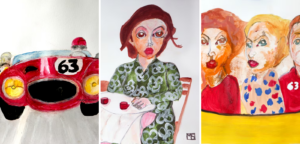
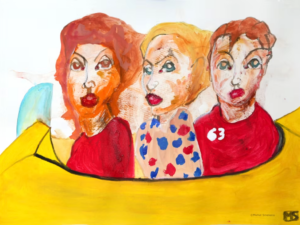
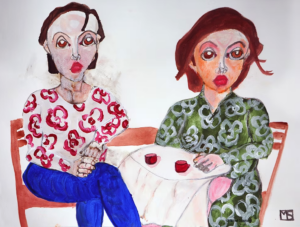
During the COVID-19 pandemic, I was commissioned by the Florence Biennale to create a work centered on the theme of eternal femininity and eternal change. There was no way I was going to depict femininity solely through the nude; I had to invent a technique to represent textiles in color. I thought of the great masters who, before the advent of paint tubes, used pigments. I mixed these pigments into a large amount of water to create a random effect, then layered a clear-line drawing in ink on top, and applied acrylic or oil by simply dipping the brush into the work. The randomness of the pigments brings the whole piece to life. Art critics say it’s something never seen before. This is my fourth artistic phase.
Period number 5
Today I’m in my fifth: I depict society, I champion the human cause, equality, respect for animal life, and the balance between cultural and economic activity. My goal is to broaden people’s perspectives, to encourage them to reflect on who they are and who they can become. Everyone needs a purpose.
You’ve opened a studio-gallery. Can you tell us about it?
I opened a studio-gallery where I welcome the public and offer drawing classes. It all started with an experience at the School of Fine Arts. A professor invited me to accompany him to a classical dance studio. There were three ballerinas who changed positions in a fraction of a second. By the time I’d gathered my supplies, they’d already changed poses dozens of times. So I decided to draw blind—without looking at my paper. And I discovered something essential: when you draw blind, the fear of drawing disappears.
Everyone knows how to draw
At school, rules are imposed that discourage some children, who end up convincing themselves they can’t draw. But everyone knows how to draw. I remember a woman who was crying in front of my artwork during an exhibition in Alençon. She’d been told she had no talent for drawing. I invited her to sit at my studio table, gave her a sheet of paper and a pen, and Martine served as her model. And she started drawing again. It’s that first step I want to offer everyone. Then you can go out into the city, sketch outdoors with a lightweight sketchpad on your lap, and eventually move on to a travel journal that combines drawing and writing. It’s like learning to ride a bike: once you know how, you can go it alone.
What do you offer at Nohô?
Two experiences. The first is a tour of the studio: you step into my world, discover my work, my creative phases, and my technique. You can also try your hand at blind drawing for the first time—this reintroduction to drawing that I offer to everyone. The second is a full-fledged art workshop consisting of four two-hour sessions—eight hours total—for both children and adults. In it, you create something, make progress, and develop your technique. What touches me deeply is this unifying spirit: the more art there is in the world—whether it’s painting, music, lace, or crochet—the better off society will be.
In summary
On Nohô, certain encounters change the way we see ourselves. Michel Smekens’s is one of them. Not a lecture, not an inaccessible demonstration: an invitation to rediscover that everyone knows how to draw, that everyone has something to express. In his studio-gallery in Le Cheylard, in the Ardèche region, this Belgian artist with an international career opens his doors to those who want to step into a unique world—and perhaps leave it a little different.
Why not follow Michel’s example and share your passion on Nohô? Create your listing for free in less than 5 minutes.
from Nohô
On Monday 31 August 2026 at 15:27
You may also be interested in these articles